


8/12/26
The Tutorial
There also is a rule for adding a Universal Quantifier. This permits the step illustrated by the following proof fragments.
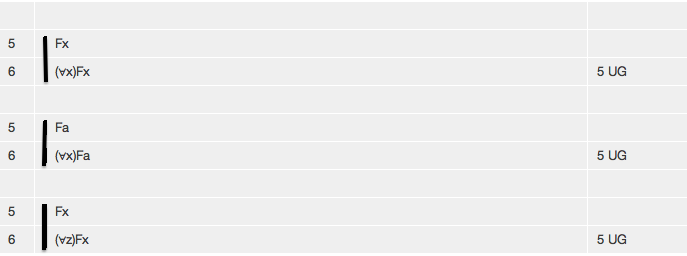
The rule is quite simple
The Rule of Universal Generalization UG
If a derivation contains a line of the form
n. <formula> <any justification>
then a line of the form
(∀<variable>)<formula> 'n UG'
may be added to the derivation, provided that <variable> is not free in the <assumptions> of the formula that is generalized (the formula of line n).
You will notice that there is a restriction on the rule-- what this is, and why it is there, will be considered in Tutorial 23.
Exercise to accompany Predicate Tutorial 9
Exercise 1(of 1)
Derive the following
(a) Fa ∴ (∀x)Fa
(b) (∀x) (Fx∧Gx) ∴ (∀x)Fx
(c) (∀x) (Fx∧Gx) ∴ (∀y)Fy
(d) ∴ (∀x)Fx≡(∀y)Fy
(e) (∀x) (Fx∧Gx) ∴ (∀y)Fy∧(∀z)Gz
(f) ∴ (∀x) (Fx∧Gx) ≡ (∀y)Fy∧(∀z)Gz
(g) ∴ (∀x) (Fx∧Gx) ≡ (∀x)Fx∧(∀x)Gx
Should you wish to use that, see Exercises for Easy Deriver using the Deriver Web Application [Gentzen] . Good advice is: start these tutorials without it, but if you get to the point of wishing to save some work, then switch to the Deriver Web Application.
Then... either copy and paste the above formulas into the Journal or use the Deriver File Menu to Open Web Page with this address https://softoption.us/test/easyDeriver/CombinedExercisesEasyDGentzen.html .